


The Best Credit Cards in Japan for Unlocking Rewards

Make your wallet work smarter in Japan by choosing the credit card that will gain you the most cash-back point incentives.
Read on for a list of the major credit card companies and their various pros and cons for expats in Japan, and a snapshot of the ideal persona for each option.
Rakuten Card—best for earning extra points
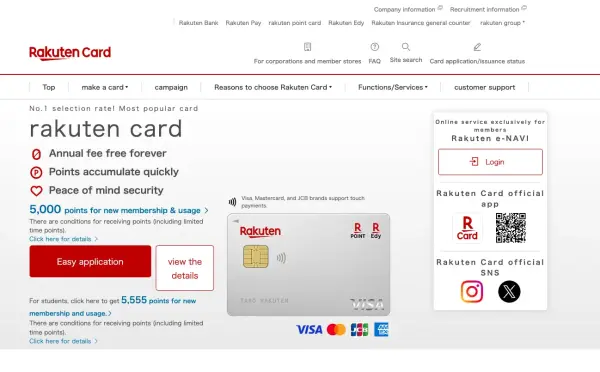
According to various surveys of netizens in Japan, the Rakuten card is one of the most used credit cards in Japan. It’s also one of the easiest for foreigners in Japan to receive.
Pros
1% cashback points (¥100 = 1 point);
Points can be used at a vast number of stores throughout Japan
No annual fees for their regular card
Contactless checkout payments with Visa touch
Free travel insurance plan
Card's overall limit range: ¥700,000 to ¥1,000,000 for established cardholders. A first-time applicant, especially a foreign resident, typically starts much lower.
Credit card types available: VISA, Mastercard, JCB, American Express
Additional credit card services: Family card
During campaign seasons, if you sign up for their credit card and mobile phone plan or bank account at the same time as the credit card, you get a bonus of between ¥5,000 to ¥30,000 cashback points.
Cons
If you're more of an Amazon shopper, then the Amazon or JCB cards will earn you more points.
If you want the ETC tie-in (highway card), that will cost you ¥550 per year on the regular card. (The ETC tie-in is free if you're on the Rakuten Gold or Premium card.)
Anyone who spends more than ¥9,000 per month on Rakuten’s ecommerce site should use the Rakuten Gold card for higher points.
Ideal for: Anyone using one or more of Rakuten's services (phone, bank, utilities, NISA, etc.). The cashback system for purchases made on the Rakuten store increases with the number of Rakuten services you use (up to 12x).
Amazon card—best for Amazon shoppers
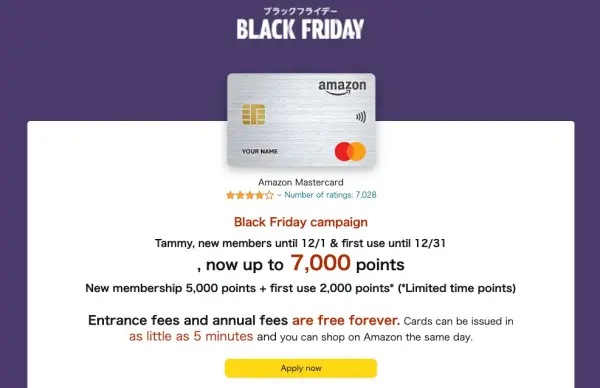
The Amazon credit card is noted by some in the expat community as an easy-to-obtain credit card. However, be warned: the application process might take a month and a half.
Pros
No annual fee
1% cashback points (¥100 = 1 point)
1.5% cashback points when shopping on Amazon; 2% cashback points if you're a Prime Member shopping on Amazon
1.5% points if you use your Amazon card at 7-eleven, Lawson, or Family Mart
Signup campaign points: ¥2,000 to ¥5,000, depending on the campaign season
Initial credit card limit: Decided on a case-by-case basis
Credit card types available: Mastercard
Additional credit card services: ETC tie-in is free
Cons
Fewer options for where to spend points when compared to Rakuten
The credit card application process can take up to 6 weeks
Does not offer VISA or JCB
Ideal for: Anyone who is a heavy Amazon shopper.
Aeon Card Select—An all-in-one credit and bank card
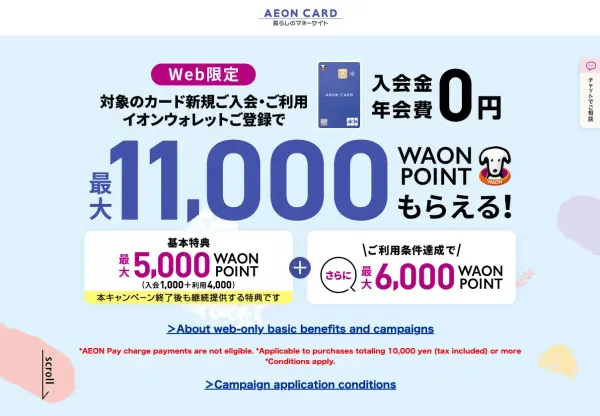
The Aeon Card Select is an excellent option for anyone who lives near any of Aeon’s big chain stores and frequently shops there. It’s also an easy card to apply for if you do so in person at a mall counter.
Pros
No annual fee
¥200 = 2 points at Aeon-affiliated stores (Aeon malls, Max Value, The Big, etc.)
¥200 = 2 points on Aeon Card W point days (10th of each month)
¥300 off for Aeon Cinema tickets if you reserve online and then pay with your Aeon credit card
Easy for foreigners to apply to if you apply in person at an Aeon mall when they are doing a signup campaign
Signup campaign points: ¥6,000 to ¥11,000, depending on the campaign season
Can get an invite for a free Aeon Gold credit card
All-in-one: Credit card, debit card, and Waon point card
Credit card limit: ¥100,000 to ¥1,000,000 per month
Credit card types available: Visa, Mastercard, JCB
Additional credit card services: Free ETC card tie-in
Cons
0.5% cashback points for shopping at non-affiliated stores; which is less than Rakuten
No travel insurance connected to the credit card
Must open a bank account at the same time
If you don't go to a counter, you'll need to apply via an online form and be familiar with typing in Japanese
Ideal for: Anyone who shops at Aeon frequently or who wants to save Waon points or create an Aeon bank account.
Mitsui Sumitomo (NL)—best card for convenience store users
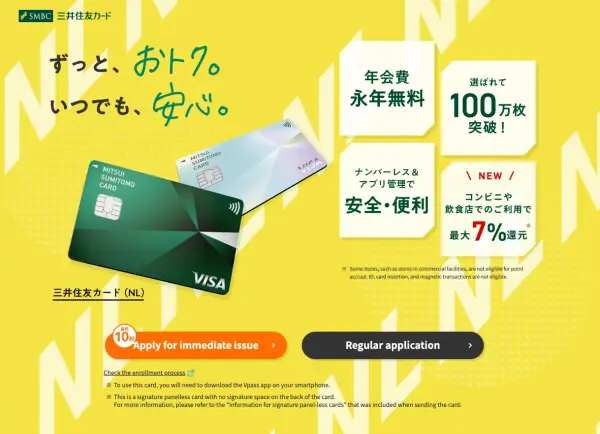
The Mitsui Sumitomo card is touted as a strong option if you’re concerned about security. There’s no number printed on the card, and it uses the one-touch contactless technology for payments.
Pros
No annual fee
7% cashback at McDonald's and participating convenience stores, but only when you tap your phone, not the physical card. Note: this rule changed on February 1, 2026. Tapping the physical card's own contactless chip now earns the standard 0.5%, not 7%. Use Apple Pay or Google Pay instead to get the full rate.
Numberless credit card makes losing the credit card less of a worry
Can also be connected to Apple Pay for mobile payments
If you spend ¥1,000,000 or more in a year, you may receive an invitation to apply for the Mitsui Sumitomo Gold (NL) card (subject to approval) with the annual fee (normally ¥5,500) waived permanently from the second year onward.
Signup campaign points: ¥6,000
Credit card limit: ¥1,000,000
Credit card types available: Visa, Mastercard
Additional credit card services: free enrollment in travel insurance
Cons
0.5% cashback for regular shopping at non-participating stores
Must use an app to check statements and confirm personal information
Ideal for: Anyone who frequents convenience stores, McDonald's, Mos Burger, Saizeriya, Gusto, Bamiyan, Coco's, Sukiya, Doutor, Jonathans, Excelsior Caffe, etc.
EPOS card—easiest starter credit card
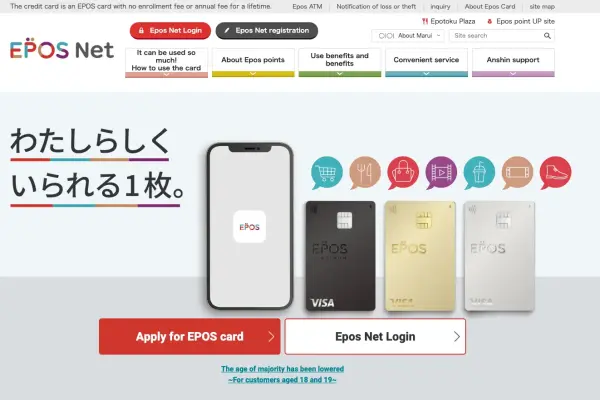
The EPOS card is another easy-to-apply for credit card if you do so in person at a Marui mall counter during a campaign season. It’s often considered a starter card in Japan and is used by many students and homemakers.
Pros
No annual fee
0.5% to 1.25% cashback points per ¥100
Touted as an easy-to-get Japanese credit card that even students and homemakers can get
Easy for foreigners to apply for if you apply in person at a Marui mall when they are doing a signup campaign
If you spend more than ¥500,000 in a year, you get a free invite to the EPOS Gold credit card
10% off at Marui during their 4x yearly sales
Signup campaign points: ¥2,000
Initial credit card limit: ¥100,000 to ¥300,000
Credit card types available: Visa
Cons
Cashback points at non-participating stores is 0.5%
No family card option, unlike Rakuten Card
EPOS Card actually includes free overseas travel insurance, up to ¥20 million in coverage. Any travel spending on the card, even a small amount, activates it.
Ideal for: The EPOS card is an easy-to-get starter card for students, homemakers, and those who want an easy path to a Gold credit card.
JCB CARD W—smart choice for spenders
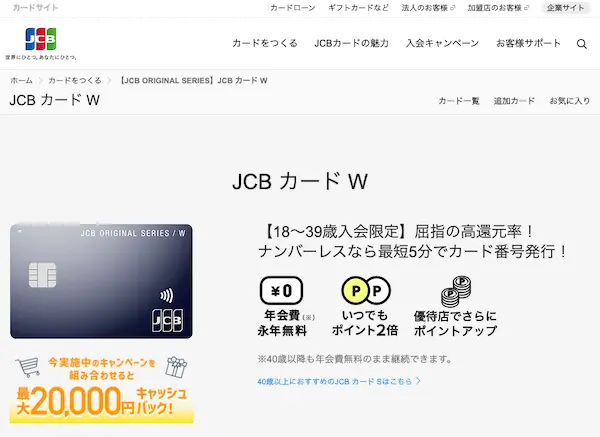
The JCB Card W is the smartest choice for young adults looking to maximize their rewards. This card offers all its benefits if you sign up between the ages of 18 and 39. Plus, you’ll keep all the benefits when you reach that age.
They have a sign-up campaign where you can earn up to 20,000 yen cashback.
Pros
No annual fee for those under 39; continuous benefits after surpassing the sign-up age
1% cash back on all purchases
2% cashback at Amazon and select convenience stores, automatically applied
Up to 10.5% cashback at select dining partners like Starbucks, after free point-up registration
Receive real-time spending notification
Credit Card Types Available: JCB only
Additional card services: numberless card option and overseas travel accident insurance
Cons
Only available for applicants aged 39 and under (18–39). Those who are already 40 cannot apply.
High cashback for specific stores and during specific times of the year
Ideal for: Those who spend primarily in Japan or travel frequently within Asia, and who can benefit from high cashback rates without worrying about annual fees.
Summary table of the best credit cards in Japan
Here, we summarize the best credit cards for foreigners to apply to.
Credit Card |
Cashback and Points |
Special Features |
Ideal For |
Rakuten Card |
・1% cashback (¥100 = 1 point) ・Up to 12x points with Rakuten services |
・Contactless payments ・Free travel insurance ・Family card option ・Bonus cashback during campaigns |
Users of Rakuten's services and frequent Rakuten shoppers |
Amazon Card |
・1% cashback ・1.5% at convenience stores ・2% for Prime members on Amazon |
・ETC tie-in free ・Targeted benefits for Amazon purchases |
Heavy Amazon shoppers |
Aeon Card Select |
・2 points per ¥200 at Aeon stores ・0.5% elsewhere |
・All-in-one credit and Waon point card ・Discounts at Aeon Cinema |
・Frequent shoppers at Aeon stores ・Those wanting an integrated bank and credit card |
Mitsui Sumitomo (NL) |
・7% at McDonald's and certain convenience stores, phone tap only ・ 0.5% elsewhere, including physical card taps |
・Numberless card ・Free travel insurance ・Automatic upgrade to Gold card on high spend |
・Convenience store frequenters ・Those concerned with security ・Great cashless payments interface |
EPOS Card |
・0.5% to 1.25% per ¥100 |
・10% off at Marui ・Invites to EPOS Gold with higher spend |
・Students, homemakers, first-time credit card users |
JCB Card W |
・1% on all purchases ・2% at Amazon and select convenience stores ・Up to 10.5% at select dining partners, with free registration |
・Numberless card option ・Real-time spending notifications ・Overseas travel accident insurance |
・Applicants aged 18-39 ・High spenders at partner locations |
au PAY Gold Card vs. Rakuten Card vs. EPOS Gold
These three cards often come up together for foreign residents comparing gold-tier options.
Card |
Annual Fee |
Best For |
Rakuten Gold |
¥2,200 |
Heavy Rakuten ecosystem users, needs ¥200,000+ Rakuten spending a year to break even |
au PAY Gold |
Varies by plan, often free with an au mobile plan |
Current au or UQ mobile users wanting bundled rewards |
EPOS Gold |
Free, by invitation only |
EPOS Card holders who spend ¥500,000+ a year and want an upgrade with no extra cost |
EPOS Gold is the easiest of the three to earn for free, since it's an automatic invite rather than a separate application. Rakuten Gold makes sense only if you already spend heavily inside the Rakuten ecosystem.
Foreigner credit card application tips
As a foreigner in Japan, getting rejected for bank accounts and credit cards is common.
But here are some times I’ve picked up and seen while living in Japan.
Apply for a credit card in person: Places such as a Marui/Kitte department store or the Aeon mall have staff who will help you with the application process, and you can get the card on the same day.
Consider department store and supermarket credit cards: These are often the easiest to obtain. Places like Marui offer the EPOS card, and Aeon Mall offers the Aeon card, which is quite lenient towards applicants.
Use your current bank account relationship: if you already have a bank account with SMBC, you can apply for their Mitsui Sumitomo credit card.
Initial acceptance to get more cards: Once you have your first credit card and a few months of credit history, you can apply for more cards much more easily.
Credit cards and cash withdrawals in Japan
In general, you can use your Japanese credit card to withdraw cash, although the particulars will depend on the specific card you have.
Credit Card |
Cash Withdrawal in Japan |
Cash Withdrawal Overseas |
Notes |
Rakuten Card |
✅ Yes |
✅ Yes |
Cashing limit required |
Amazon Card (SMBC) |
✅ Yes |
✅ Yes |
Setup via Vpass app |
EPOS Card |
✅ Yes |
❓ Not clearly stated |
Strong domestic support |
Mitsui Sumitomo NL |
❌ Not confirmed |
❌ Not confirmed |
No official info found |
Aeon Card Select |
❌ Not confirmed |
❌ Not confirmed |
Focused on Waon/AEON integration |
JCB Card W |
❌ Not confirmed |
❌ Not confirmed |
Focused on shopping/insurance |
How to optimize credit card spending in Japan
The secret to maximizing credit card rewards is knowing where each card shines and planning your spending accordingly. The Rakuten Card gets ridiculously good when you use multiple Rakuten services—phone, internet, shopping, banking. Stack enough services and you can hit 10-12% back on Rakuten purchases, which is insane by any standard.
Seasonal bonuses are where the real money is, but you need to pay attention. JCB Card W runs campaigns all the time, sometimes doubling or tripling points at specific stores. Time a big purchase right and you can earn months' worth of regular rewards in one go. The key is actually reading those promotional emails instead of deleting them.
Don't sleep on utility bills—it's free money sitting there every month. Most utilities accept credit cards now, and while some charge processing fees, the math usually works out in your favor. Set up autopay for electricity, gas, water, and internet, and you'll earn points without thinking about it.
Card Type |
Best For |
Avoid For |
Pro Tip |
Rakuten Card |
Rakuten online shopping and ecosystem purchases |
Non-Rakuten shopping |
Stack services for massive multipliers |
Amazon Card |
Amazon + convenience stores |
Everything else |
Prime membership boosts Amazon rewards |
JCB Card W |
Partner stores + campaigns |
Regular purchases |
Watch for limited-time bonuses |
Mitsui Sumitomo |
McDonald's + conbini |
Department stores |
Use contactless for 7% back |
A typical expat spending ¥200,000 monthly spends ¥2.4 million a year. A Rakuten Card at 1% cashback earns about ¥24,000 a year on that spending.
An Amazon Card earns a similar ¥24,000 to ¥36,000 a year, depending on how much of that spending happens on Amazon or at partner convenience stores. These numbers assume ordinary spending, not special campaign categories.
The Mitsui Sumitomo Card can be a goldmine if you eat at McDonald's and shop at convenience stores regularly. That 7% back adds up fast—someone spending ¥50,000 monthly at participating stores could earn ¥42,000 annually. But if you don't fit that spending pattern, you'll barely earn anything.
Annual Spending |
Rakuten Earnings |
Amazon Earnings |
JCB W Earnings |
Mitsui Sumitomo Earnings |
¥1.2M |
¥12,000 |
¥12,000-18,000 |
¥12,000-30,000 |
¥6,000-84,000 |
¥2.4M |
¥24,000 |
¥24,000-36,000 |
¥24,000-60,000 |
¥12,000-168,000 |
¥3.6M |
¥36,000 |
¥36,000-54,000 |
¥36,000-90,000 |
¥18,000-252,000 |
Annual fees kill returns fast. The Rakuten Gold Card needs ¥200,000 in Rakuten shopping just to break even on its ¥2,200 fee. Premium cards often require spending levels that most people never reach. Be honest about your spending patterns before paying annual fees.
Credit cards in Japan that include travel insurance
One major perk of certain Japanese credit cards is complimentary travel insurance. While coverage varies depending on the card, it can provide valuable peace of mind when you're traveling abroad—or even domestically in some cases.
Most credit cards that include travel insurance fall under two categories:
利用付帯 (riyō futai) — Coverage only applies if you use the card to pay for travel-related expenses (e.g., plane tickets, hotel bookings).
自動付帯 (jidō futai) — Coverage applies automatically, regardless of how you paid for your trip (common with gold or premium cards).
Here’s a breakdown of the major cards offering travel insurance benefits:
Card Name |
Insurance Type |
Coverage Style |
Max Coverage |
Rakuten Card |
Overseas travel |
利用付帯 |
Up to ¥20 million |
EPOS Card |
Overseas travel |
自動/利用付帯 |
¥500K–¥20 million |
JCB CARD W |
Overseas + shopping |
利用付帯 |
Up to ¥20 million |
Mitsui Sumitomo (NL) |
Overseas travel only |
利用付帯 |
Up to ¥20 million |
Mitsui Sumitomo Gold (NL) |
Overseas + domestic travel |
利用付帯 |
Up to ¥20 million |
Aeon Gold Card (Invite-only) |
Overseas + domestic travel |
自動付帯 |
Up to ¥50 million |
Amazon Mastercard |
Overseas travel |
利用付帯 |
Up to ¥2 million |
💡 Note: The regular Aeon Card Select does not include travel insurance, but the Aeon Gold Card (available by invitation) does.
For frequent travelers, especially those flying internationally, choosing a card with built-in travel insurance can reduce the need to purchase separate policies. Just make sure to review each card’s policy details and confirm whether the coverage is automatic or requires using the card for travel purchases.
What to know about credit score building in Japan
Japan's credit system is nothing like what you're used to back home. There's no single credit score that follows you around—instead, each bank keeps its own records and makes decisions based on their internal systems.
Japan has three main credit bureaus: JICC, CIC, and KSC. Banks tend to use KSC, while credit card issuers and consumer finance companies tend to use CIC and JICC.
These bureaus don't fully share everyday data with each other. But they do cross-share serious delinquency records, so a missed payment reported to one can still surface elsewhere.
Your good credit history from overseas means nothing here. Japan doesn't recognize foreign credit scores at all, so every foreign resident starts from zero.
Building credit in Japan takes time and patience. Most financial institutions want to see at least six months of perfect payment history before they'll even consider raising your credit limit or offering you better products. Don't expect much at first—most foreigners start with limits between ¥100,000 and ¥300,000, regardless of their income or positive credit history. It's frustrating, but that's just how conservative Japanese banks are.
The good news is that after about a year of consistent payments, doors start opening. Japanese banks love "relationship banking"—the more products you have with them (savings account, salary deposit, insurance), the better they treat you. This is why many expats find success by consolidating their banking with one institution rather than shopping around for the best rates.
Why do credit card issuers reject foreign applicants?
Japanese credit card issuers score every application internally. Foreign residents often face extra scrutiny, even with a stable income.
What issuers actually check
Each credit card company reviews more than your income. They also weigh:
Your employer type. A large Japanese company scores better than a small or foreign-owned one.
Your employment type. A full-time employee scores better than a contract or part-time worker.
How long you've lived at your current address.
Whether other issuers have rejected you recently. Rejections are visible to other issuers through shared credit bureau data.
How to improve your odds
Open a Japanese bank account first. Almost every credit card company requires one for automatic bill payment.
Avoid applying to several credit card companies in a short window. Each rejection makes the next application harder, not easier.
Build a track record first. A Japan Post Bank or Seven Bank account, a phone contract, or a small EPOS Card can establish a positive credit history before you apply for a bigger card.
How to pay your credit card bill in Japan
Paying your credit card bill in Japan is more straightforward than getting approved for the card in the first place, but there are some quirks you need to know about.
Most Japanese credit cards use automatic bank withdrawals as the default payment method, which means you'll set up a direct debit from your Japanese bank account when you apply. This happens on a specific date each month—usually the 27th—and if there's not enough money in your account, you'll get hit with late fees and potentially damage your credit standing.
The automatic withdrawal system works well once you get used to it, but it can catch newcomers off guard. Unlike credit cards in other countries where you might pay online, send a check, or use cash payments, Japanese cards expect you to maintain sufficient funds in your designated bank account.
You'll typically get your statement about a week before the withdrawal date, giving you time to transfer money if needed. Most cards send statements both physically and electronically, though navigating the online portals in Japanese can be challenging initially.
If automatic withdrawal fails or you want to make additional payments, you have several options. Most convenience stores accept credit card payments at their ATMs or service counters—just bring your statement and cash. Online banking through credit card issuer's website or app is becoming more common, though English support varies.
Some cards also accept payments through bank transfers, but you'll need to use the specific account numbers and reference codes provided by your card company.
Understanding revolving payments and interest rates in Japan
Revolving payments (リボ払い) in Japan work differently than you might expect, and honestly, they're usually a bad deal.
Unlike other countries where you can choose to pay a minimum amount each month, Japanese revolving payments typically involve paying a fixed amount regardless of your balance. So if you set up ¥10,000 monthly payments and charge ¥50,000, you'll be paying that same ¥10,000 every month until the balance is cleared—plus interest that can reach 15-18% annually.
The sneaky part is how aggressively Japanese card companies push revolving payments. They'll offer promotional campaigns with bonus points if you sign up for revolving, or they'll make it the default option during card applications.
Some cards even automatically convert large purchases to revolving payments unless you specifically opt out. The Rakuten Card is notorious for this—they'll send you offers to convert purchases to revolving with "convenient low monthly payments" that end up costing you hundreds or thousands of yen in interest.
Most financial advisors recommend avoiding revolving payments entirely unless you're facing a genuine emergency. The interest rates are high, the payment structure is inflexible, and it's easy to lose track of how much you're actually paying.
If you do find yourself in revolving debt, you can usually pay it off early through online banking or by calling customer service. Just make sure you understand the payoff process—some cards make it unnecessarily complicated to discourage early payment.
Frequently asked questions
What are the eligibility requirements for Japanese credit cards?
To be eligible for a Japanese credit card, you must be on a valid non-tourist visa and provide a bank account and valid ID (passport, My Number card, driver's license, residence card, health insurance card, etc.). Some banks may also ask you for your inkan (personal seal) and a tax slip showing your previous year's income.
Which is the easiest credit card for foreigners to get in Japan?
The easiest credit cards for foreigners to get in Japan are the Rakuten credit card and the Amazon credit card for those applying online. For those applying in person at a counter, the Aeon credit card and the EPOS credit card are reputed to be easy to apply for, as the staff will help you enter your middle name in the credit card application.
What are some tips for getting a credit card in Japan?
One of the most-touted tips for getting a credit card in Japan is to apply at a mall counter and fill out a paper-based credit card application. The staff will help you enter your middle name correctly into their system, which is often a sticking point for foreigners applying online. And they will also walk you through all the other information you will need to provide. Other tips to keep in mind: Avoid asking for "キャッシング機能" as this is sometimes a red flag and could prevent you from being issued a credit card. Also, if you fail an application, wait 6 months before applying. This way, credit card screening about the failed application won't be available for the next credit card company to access.
Do Japanese credit cards work abroad?
Yes, as long as it’s a global brand (Visa, Mastercard, AmEx, JCB). Make sure you enable international usage and check foreign transaction fees (typically 1.6%–2.2%).
Can I link my card to mobile payments like Apple Pay or Google Pay?
Yes, many cards like Mitsui Sumitomo (NL), Rakuten, and EPOS support Apple Pay and Google Pay. However, compatibility depends on your phone model and the card brand (Visa/Mastercard/JCB).
What happens if I lose my card?
Most issuers allow you to freeze or cancel your card via app or phone support. Numberless cards like Mitsui Sumitomo NL or JCB CARD W offer added security if your physical card is lost.
Can I increase my credit limit later?
Yes, most issuers allow limit increases after 6–12 months of on-time payments. Some may request proof of income again.
Do Japanese credit cards charge monthly fees?
Most Japanese credit cards charge an annual fee, not monthly fees. Many popular cards, including Rakuten Card and EPOS Card, charge no fee at all.
Paying your full balance on time each month helps you save money and build a good credit score. Late or partial payments do the opposite.
What is the credit card screening process like for foreign nationals?
Every Japanese credit card issuer runs a screening process on each application. Foreign nationals and other international residents often face extra scrutiny during this step.
You'll usually need your zairyu card (residence card), plus other documents like proof of income. A stable job and an existing Japanese bank account both work in your favor with the issuing bank.
How long does it take to receive a credit card after approval in Japan?
Most issuing banks mail your card about two weeks after approval. Card usage can start as soon as it arrives and you activate it.
Non-Japanese residents sometimes face a longer review before approval. Build this extra time into your plans if you need the card by a specific date.
Can I use my Japanese credit card for foreign currency purchases?
Yes. Most Japanese credit cards work at Visa merchants and other locations that accept international brands worldwide.
Your statement automatically converts foreign currency purchases into yen. Check your card's foreign transaction fee before relying on it for large purchases abroad, such as airline tickets.
What other recommended credit cards should I consider in Japan?
Several store-branded cards offer special discounts beyond the cards in this guide.
The Lumine Card gives a permanent 5% discount at Lumine and NEWoMan stores. It's free in your first year, then ¥1,048 a year after that.
The MUJI Card earns extra points at MUJI stores and includes free overseas travel insurance. The Visa version has no annual fee at all.
The JAL Card earns airline miles toward JAL flights and airline tickets on every purchase, making it a strong pick for frequent travelers.
Each of these cards offers other benefits beyond its main store discount. Compare them against your own spending habits before you apply.
Does my existing bank account affect my credit card approval?
Often, yes. Many issuing banks favor applicants who already hold an account with them.
Opening a Rakuten Bank account before applying for a Rakuten Card can work in your favor during screening. The same logic applies to other card-and-bank pairings across Japan.
Does a Japanese credit card include domestic travel insurance?
Some do, but it's less common than overseas coverage. The base Mitsui Sumitomo (NL) card covers overseas travel only.
Its Gold (NL) tier adds domestic travel insurance on top, and the invite-only Aeon Gold Card includes both as well.
Check your specific card's insurance terms before you travel. Domestic coverage details often differ from the overseas policy on the same card.
Can I withdraw cash with my credit card like an ATM card?
Your credit card is not the same as a debit card or ATM card. Withdrawing cash through your credit card uses its cash advance feature instead, which charges interest right away.
For everyday cash needs, use a separate debit card or ATM card linked to your Japanese bank account. This keeps your card usage simple and avoids extra interest charges.
In closing
The best Japanese credit card is one that aligns with your personal spending habits, lifestyle, and financial goals.
Whether it's the Rakuten Card for those who plan to use the Rakuten ecosystem, the Amazon Card for frequent Amazon shoppers, or the Aeon Card Select for Aeon loyalists, each card has unique benefits tailored to different needs.
Understanding the pros and cons, eligibility requirements, and application tips for each option ensures you will make an informed choice.
Spending too long figuring out your Japanese mail?
Virtual mail + translation services start at 3800 per month. 30-day money-back guarantee.